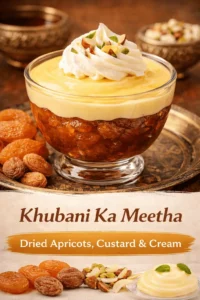
The Heartbeat of My Society – Hyderabadi Khubani Ka Meetha Role, More Than a Dessert.
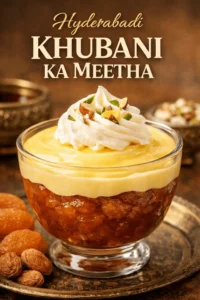
I observed that if you walk through the vibrant streets of Hyderabad or step into any festive gathering in our community, there is one golden hue that catches your eye before anything else – the Hyderabadi Khubani Ka Meetha role.
It’s not the jewellery or the clothes; it’s the fantastic deep-orange glow of Khubani Ka Meetha sitting on my dessert table.
Today, I want to take you beyond the kitchen.
I want to share the “role” this dessert, Khubani Ka Meetha, plays in my society—why it’s the silent witness to our joys, our weddings, and our everyday family bonds.
Read more about my signature serving style.
Whether you are reading this from a busy street in Karachi, Liyari, Clifton, Defence, Korangi, or a cosy apartment in New York, come with me into the heart of my culture – the heartbeat of my society: Hyderabadi Khubani Ka Meetha Role, More Than a Dessert.
Read more about my ultimate dinner party guide.
My Unspoken Rule: “Dawat is Incomplete Without Khubani Ka Meetha”
It is customary to organise a Dawat (feast) for guests in my family and society.
I can serve the finest biryani and the most succulent kebabs, but if there is no Khubani Ka Meetha at the end, did the party even happen in my house? No, of course not.
Read more about the Hyderabadi moment of truth – Khubani Ka Meetha vs. Double Ka Meetha.
I remember my mother-in-law used to say, “Biryani is the king, but Khubani is the royalty that gives the king his grace.”
Growing up, I watched how Hyderabadi Khubani Ka Meetha acted as a social bond.
Hyderabadi Khubani Ka Meetha is the dish that everyone waits for.
Read more about when I invited my parents for dinner.
When the host brings out the bowls of stewed apricots topped with malai, the conversation shifts.
People stop talking about politics or work and start talking about the flavour.
That is the power of Khubani Ka Meetha—it brings my people into the present moment.
Read more about the best dessert to try online.
For Me,
Hyderabadi Khubani Ka Meetha is the symbol of celebration and togetherness.
In my daily life and my business at Hyderabadi Meetha Online, I see how this dessert marks milestones.
My family’s weddings: Hyderabadi Khubani Ka Meetha, the “Grand Finale”.
Read more about why my homemade khubani meetha is loved by my entire family.
When I saw a massive silver dish full of Khubani Ka Meetha at a wedding, it wasn’t just about food; it represented the generosity of the host.
Read more about why my homemade desserts are better.
My Eid Mornings: While in my family, many go for Sheer Khurma, in many households (including mine!), a side of Khubani is essential to balance the milky sweetness of my day.
Read more about I love Khubani dessert.
My New Beginnings: I must remember that when someone moves into a new house or celebrates a child’s success among my relatives, I must send a bowl of homemade Hyderabadi Khubani Ka Meetha.
Read our mission.
It is my way of saying, “May your life be as sweet and rich as Khubani Ka Meetha.”
I tell you, from local tradition to international craving for Hyderabadi Khubani Ka Meetha.
To my international readers, you might wonder: I tell you the fact – how does a simple apricot dish (Khubani Ka Meetha) hold so much weight?
It’s because of the patience it requires.
I know our society values things made by hand and with time and care.
I’m soaking the apricots overnight, carefully deseeding them, and slow-cooking them until they reach that perfect jam-like consistency, which is absolutely loved by my entire family.
When I introduce my signature Khubani cups for Hyderabadi Khubani Ka Meetha, I’m not just sending food.
I’m sending a piece of my society’s history.
Read more about healthy iftar desserts.
I am sure for those readers living abroad, one bite of this meetha is a direct flight back to their mother’s kitchen.
At least for me, it’s a connection to their roots that no supermarket pudding can ever replace – Khubani Ka Meetha.
Now I Discuss
The Perspective of “Health Meets Heritage”
As all of you and I know, in today’s world, we are all becoming more health-conscious, especially my father-in-law and my mother-in-law.
Read more about the traditional and nutritional perspectives.
What I love about the role of Khubani in our daily lives is that it’s a “guilt-free” tradition – Hyderabadi Khubani Ka Meetha.
I noticed that, unlike many desserts that are just “empty calories”, I noticed deeply the role Khubani plays in its nutrients.
If I am not wrong, the elders knew this!
Read more about why kids and adults love this meetha.
I observed they knew that after a heavy meal of meat and rice, the fibre in apricots helps with digestion.
In my daily routine, I’ve seen how this traditional wisdom still holds – Hyderabadi Khubani Ka Meetha.
I truly advise it’s a dessert that looks after you while you enjoy it.
My Personal Mission as a “Hyderabadi Khubani Ka Meetha” Entrepreneur
When I started my brand, I didn’t just want to sell a product.
Read more about when I start the preparation of Khubani dessert as my brand identity.
I wanted to preserve the role of this dessert (Khubani Ka Meetha) in our modern, fast-paced society.
I noticed that we are losing the habit of slow-cooking.
I also noticed people are moving towards instant snacks.
Read more about the yummiest dessert ever.
By offering my traditional Hyderabadi Khubani Ka Meetha, I am trying to keep that “Dawat culture” alive for the next generation.
I want the kids of today to have the same “wow” moment when they see that golden bowl of apricot dessert.
I Try To Tell You
Why You Need a Bowl of Khubani Today
I sincerely told you that you don’t need a massive wedding to enjoy the role of this dessert.
In my society, we often make a small batch just because it’s raining or because a friend dropped in suddenly.
Read more about the importance of apricots.
In my family, Khubani Ka Meetha represents hospitality.
I ever observed, in a world that is becoming more digital and distant, sitting down with a friend over a bowl of Khubani Ka Meetha is an act of rising.
My Final Thoughts
My personal opinion is that Khubani Ka Meetha is the story of my people.
I truly say the Khubani dessert is mouth-watering; it is sweet, it is rich, and it is light in nature—just like my society.
Read more about the day when both my kids fell in love with this sweet.
I want to hear from you:
Is there a specific food in your culture that makes a party feel “official”?
Does Khubani remind you of a specific person or memory?
Feel free to contact us.
Share your stories in the comments below!
I would love to read every single one of them.